
Synthesis against Yosys 0.33 (v3.0.0)
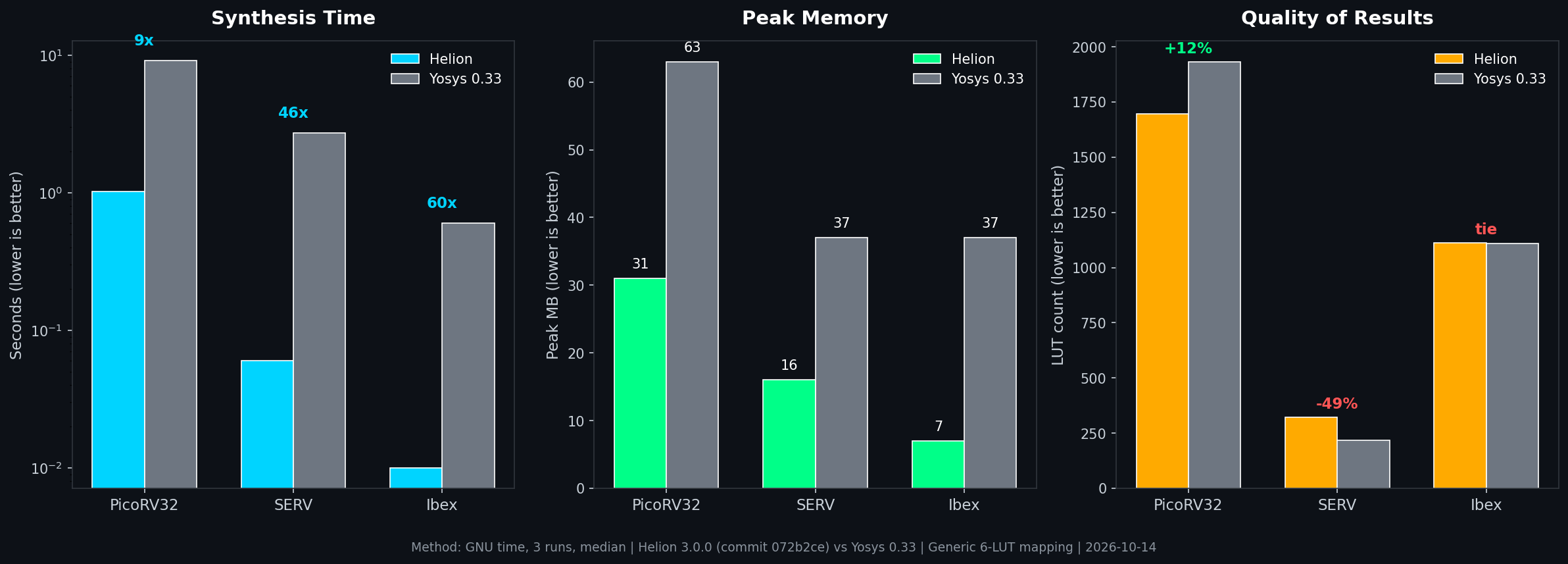
Helion v3.0.0 vs Yosys 0.33, synthesis only, generic 6-LUT mapping, measured 2026-10-14 with GNU time (3 runs, median). Same RTL, same target, same stage. Every number below is measured, and the caveats are printed next to the numbers.
| Design | Helion time | Yosys time | Speedup | Helion mem | Yosys mem | Helion LUTs | Yosys LUTs |
|---|---|---|---|---|---|---|---|
| PicoRV32 | 1.02 s | 9.12 s | 8.9x | 31 MB | 63 MB | 1,697 | 1,932 |
| SERV | 0.06 s | 2.73 s | 45x | 16 MB | 37 MB | 323 | 217 |
| Ibex | 0.01 s | 0.60 s | 60x | 7 MB | 37 MB | 1,112 | 1,110 |
Method: /usr/bin/time -v, 3 runs each, median. Helion: helion synth <design>.v (commit 072b2ce). Yosys: yosys -p "read_verilog <d>.v; synth -top <top>; abc -lut 6; stat". Full report: benchmark-report-2026-10-14.md.
Honesty check: on SERV, Yosys produces 33% fewer LUTs than Helion; that QoR gap is the next optimization target. On PicoRV32 Helion uses 12% fewer LUTs. Speed and memory wins are consistent; area is mixed.
Full flow against Yosys and nextpnr (v2.0.5)
Ten real designs with identical RTL: Helion 2.0.5 against Yosys 0.69 with nextpnr-ecp5, measured on 2026-10-10 on Linux x86_64. Helion targeted its HL10T die (8,192 LUT6); the baseline targeted a Lattice LFE5U-25F (24k LUT4) at 100 MHz. Every number below is measured; the caveats follow the table.
| Design | Helion LUT6 | Helion WNS (ps) | Helion wall | Baseline LUT4 | Baseline wall | Result |
|---|---|---|---|---|---|---|
| PicoRV32 | 2,477 | 8,700 | 3.5 s | 830 | 10.4 s | Both complete |
| AES-128 | 6,534 | 8,700 | 1.9 s | 11,584 | ~332 s | Both complete |
| SHA-256 | 1,865 | 8,220 | 0.9 s | 2,753 | ~146 s | Both complete |
| UART | 379 | 9,600 | 0.3 s | 133 | 5.8 s | Both complete |
| SPI master | 62 | 9,580 | 0.03 s | 13 | 3.6 s | Both complete |
| I2C master | 822 | 9,580 | 0.9 s | 183 | 5.0 s | Both complete |
| SERV | 395 | 7,620 | 0.7 s | 133 | 1.9 s | Both complete |
| MIPS single-cycle | 397 | 9,600 | 0.09 s | Yosys rejected an inferred latch in the RTL | Helion only | |
| CORDIC | 385 | 9,600 | 0.08 s | Yosys could not elaborate a variable-bound loop | Helion only | |
| Ibex RV32 | About 11.6k LUTFF needed; HL10T has 8,192 | Yosys 0.69 could not parse the assignment patterns | Over capacity | |||
Full report with stage breakdowns, method and reproduction steps: benchmark-report-2026-10-10.md. In the 2.0.5 flow the over-capacity Ibex run was clipped to the die rather than refused; the full Ibex core now targets the larger HL10S-C64-1.
How to read these numbers
- Different fabrics. Helion's LUT6 die and a Lattice LUT4 part are not silicon-to-silicon comparable; absolute LUT counts and MHz should not be compared head to head.
- Runtime. Helion ran 3 to 100 times faster in wall-clock time on identical RTL (AES-128: 1.9 s against about 5.5 minutes). Helion's flow is a straight pipeline; Yosys spends its time in ABC and nextpnr in annealing placement.
- Area. Yosys with ABC still produced 2 to 5 times fewer LUTs. Part of that is LUT4 against LUT6 accounting; most of it is ABC's logic optimization. Closing that gap is ongoing work.
- Timing. Every completed Helion run met the 10 ns target, but Helion's delay model is simpler and more optimistic than nextpnr's. Calibrating it is on the roadmap.
- Frontend coverage. Helion's SystemVerilog frontend parsed all ten designs, including three the baseline could not.
Measured improvements
| Campaign | Result |
|---|---|
| Performance (2.1) | Synthesis frontend allocations 12.7M to 409k (down 97%); frontend wall time down 69% |
| Area (2.1) | uart 420 to 244 LUTs (down 42%); PicoRV32 down 19% from AIG rewriting and a further 10% from cross-cone sharing, each step proven equivalent |
| Gold | WNS_PS=9640 on examples/counter.sv unchanged throughout |